A 10-Inch Homelab Rack, Printed in PETG
A switch needed a mount, and that turned into a whole rack: a printed 10-inch frame holding two ZimaBoards, a 2.5GbE switch and a drive. The models, the material, and what's still unfinished.
The hardware sitting in this rack was provided free of charge: the 2.5GbE switch by TP-Link, the two ZimaBoards by IceWhale. The rack itself I printed and paid for. Details under Disclosures.
This started as a much smaller project. I had a 2.5GbE switch sitting loose on a shelf and went looking for a way to mount it properly. I found a print model for exactly that switch, and once there was a mount there had to be something to mount it in.
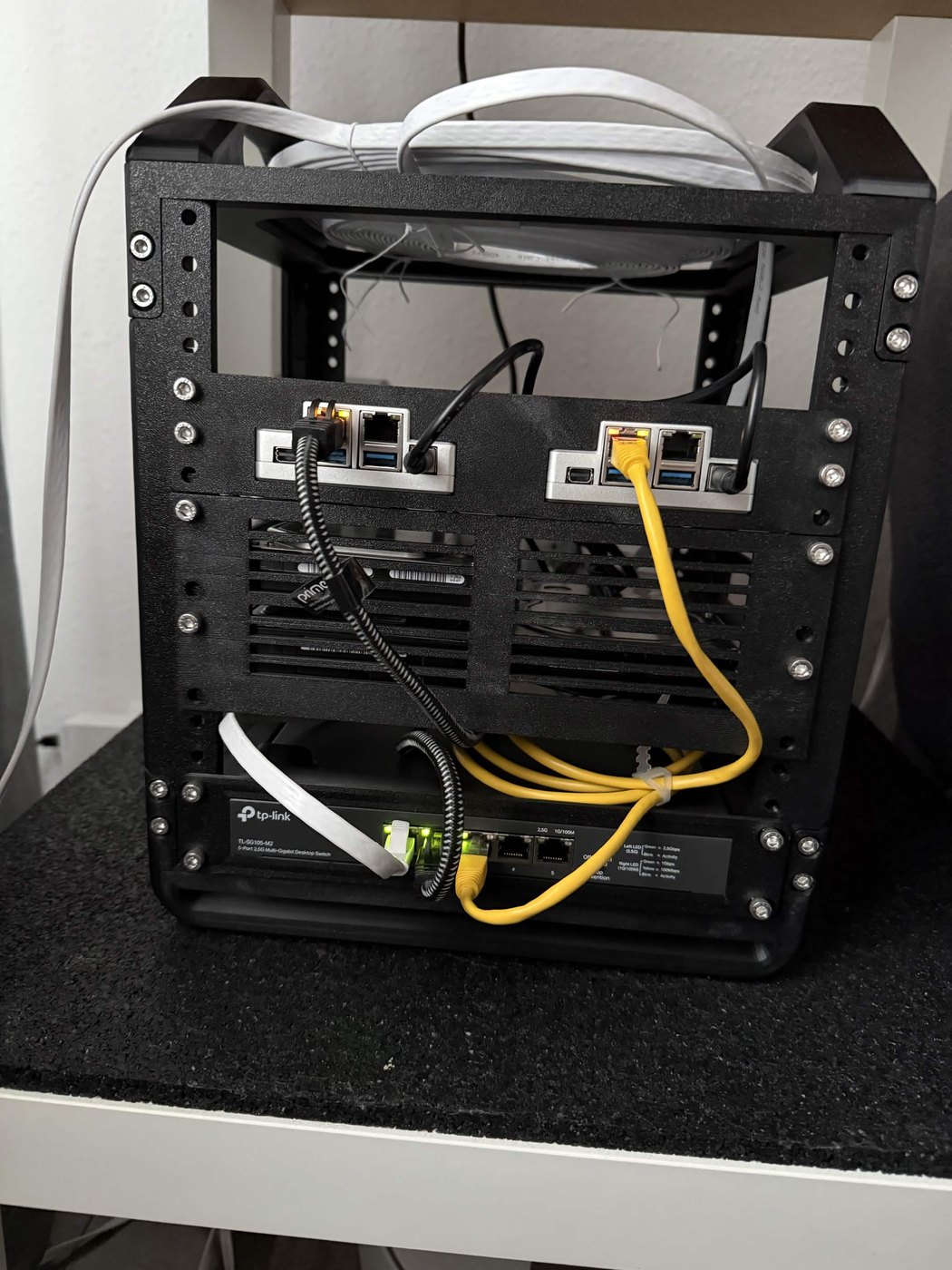
What’s in it
From the bottom up: a TP-Link TL-SG105-M2, five 2.5GbE ports, which everything fast in the house now hangs off — the 2.5GbE measurements are in the router test log. The drives sit above it, and both ZimaBoards go on top, side by side. One runs the services I rely on; the other is the 16 GB model from the buying guide and is still waiting for a job.
Everything printed from community models:
- KWS Rack V2 — the frame
- TL-SG105-M2 1U mount — the part that started it
- 10-inch rackmount for 2× ZimaBoard 2
All printed in PETG Matte on a Bambu Lab A1 with AMS, and the screw sizes are listed on the rack model’s page, so there’s nothing to work out there.
PETG for a rack rather than PLA is worth a sentence. The frame carries weight and sits near hardware that runs warm around the clock, and PLA softens at temperatures a closed rack can plausibly reach on a summer day. PETG costs a bit of print quality on overhangs and gains a part that won’t sag.
The drive bracket is the odd one out. That one I had generated rather than printed from an existing model. It holds the drives and it does the job, but it’s the part I’m least happy with and it’s getting replaced.
The switch
Since it’s what set this off, the TL-SG105-M2 deserves more than a name.
| TL-SG105-M2 | |
|---|---|
| Ports | 5× 100M / 1G / 2.5G, auto-negotiation, auto-MDI/MDIX |
| Management | none — unmanaged, plug and play |
| Switching capacity | 25 Gbps |
| Forwarding rate | 18.6 Mpps |
| MAC table | 16K |
| Jumbo frames | 10 KB |
| QoS | 802.1p / DSCP, 802.3x flow control |
| Cooling | fanless, metal casing |
| Power | external 12 V / 1 A adapter, max 12.11 W |
| Dimensions | 209 × 126 × 26 mm |
| Operating temperature | 0–40 °C |
Three of those lines mattered for putting it in a rack.
Fanless with a metal case. The case is the heatsink, which is the right way round for an enclosed frame: nothing to add noise, nothing to clog with dust. The 0–40 °C operating range is worth a thought if your rack lives somewhere warm, though with a 12 W ceiling there isn’t much heat to get rid of.
209 mm wide. That’s what makes a 10-inch mount possible at all; the frame’s usable width is around 254 mm.
An external power brick. Like everything else here, so the multi-socket strip behind the rack is carrying four wall warts. Not elegant, and not something a printed frame solves.
The thing it doesn’t do is management. No VLANs, no port mirroring, no web interface. For splitting traffic I’m relying on the router, which is a different article. If you want segmentation at switch level, this isn’t the model to buy — and at this price it was never pretending to be.
In use it has been unremarkable in the way network hardware should be: plugged in, negotiated 2.5G on both ports that matter, and carried 2.35 Gbit/s with no retransmits. Cat5e is enough for that, so nothing in the walls had to change.
Why 10 inch
A full 19-inch rack is built for equipment I don’t own and wouldn’t fit in the room. Ten inch is the size where a ZimaBoard, a desktop switch and a drive stop being loose objects on a shelf without the whole thing becoming furniture. The boards draw under 3 W each at idle, so there’s no cooling problem to design around either.
The frame is also designed to be extended. If another switch or another board turns up, it grows upward rather than needing a replacement — which, given how this project started, is probably worth planning for.
Power is a plain multi-socket strip behind it. Nothing clever.
What isn’t finished
The cable management. The patch cables are longer than they need to be and the slack is looped rather than routed. It works and it’s untidy, and it’s visible in the photo above because photographing it from a flattering angle wouldn’t change the fact.
That and the drive bracket are the next jobs.